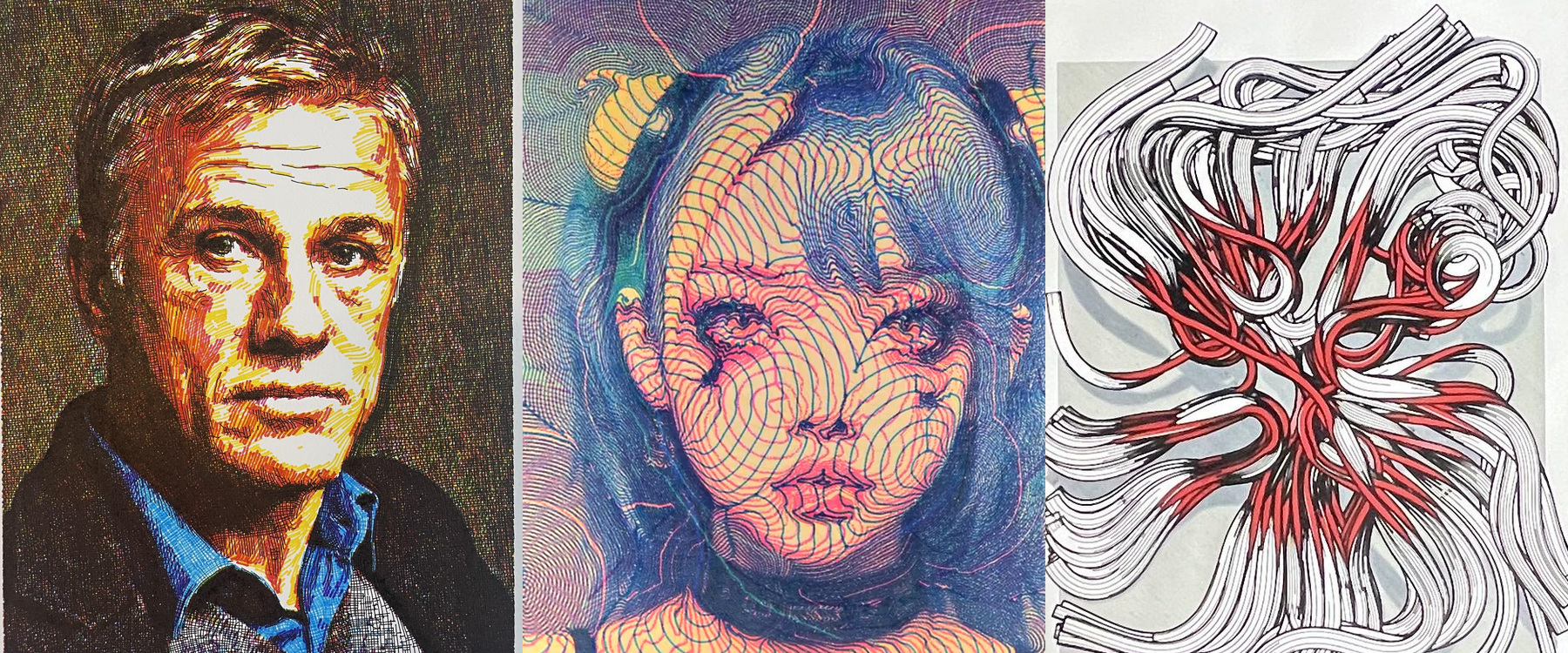
Featured image: details from Aleksandra Jovanić’s random-walk zine, Chloe_Lai’s photo-to-graphic experiment, and The Applied Craft’s map-making reel. Sources linked below.
Three recent finds bring together ideas for small books, image-making and plotted lines. They come from different processes, but each offers something to explore in a future drawing or zine.
A random walk you can fold into a zine
Aleksandra Jovanić's First steps with a RANDOM WALK is an activity guide for getting started with random walks in p5.js. Her post shows the guide laid out as a small folded publication, with code, diagrams and examples sharing the sheet. She credits Manfred Mohr's 1969 works P-10 and P-18, both titled Random Walk, as the inspiration for the sketch.
This connects directly with the zine work in CDW. A sequence of panels could show how one set of rules develops, rather than simply collecting eight unrelated images. The instructions can become part of the artwork, giving the reader a way to try the idea themselves.
See Aleksandra's post · Processing Community Day Zine Library
Finding a simpler visual language in a photograph
Chloe_Lai (@lch1776244) shares photographs paired with graphic reinterpretations: a cat among plants, a mountain landscape and a pomegranate still life. The second versions reduce the scenes into shapes, a limited palette and carefully arranged spaces.
The account presents AI experiments and includes a prompt with this post. These are useful as composition references, not evidence of finished pen plots or ready-to-plot vector files. For my own work, the interesting question is how much of a scene can be removed while keeping its character. That could become a good exercise in separating a drawing into a few deliberate pen layers.
A map as a drawing
The Applied Craft (@theappliedcraft) shares a reel about map-making software. The visible example turns a network of streets into a spare line composition, surrounded by open paper. The caption points to app.appliedcraft.com and includes plotter and vector-design references.
Maps offer another way to think about line density. A dense street network already carries rhythm, texture and recognizable structure. Selecting what to include, and how much empty space to leave around it, becomes a drawing decision. This is worth keeping beside the terrain and contour experiments rather than treating every map as a conventional labeled diagram.
Ideas to carry forward
A small book that explains a generative rule. A photograph simplified into a few plotting layers. A map composed as line art. All three suggest experiments that can start small and develop through physical tests on paper.