STUDIO JOURNAL
Early conversations, March–July 2026
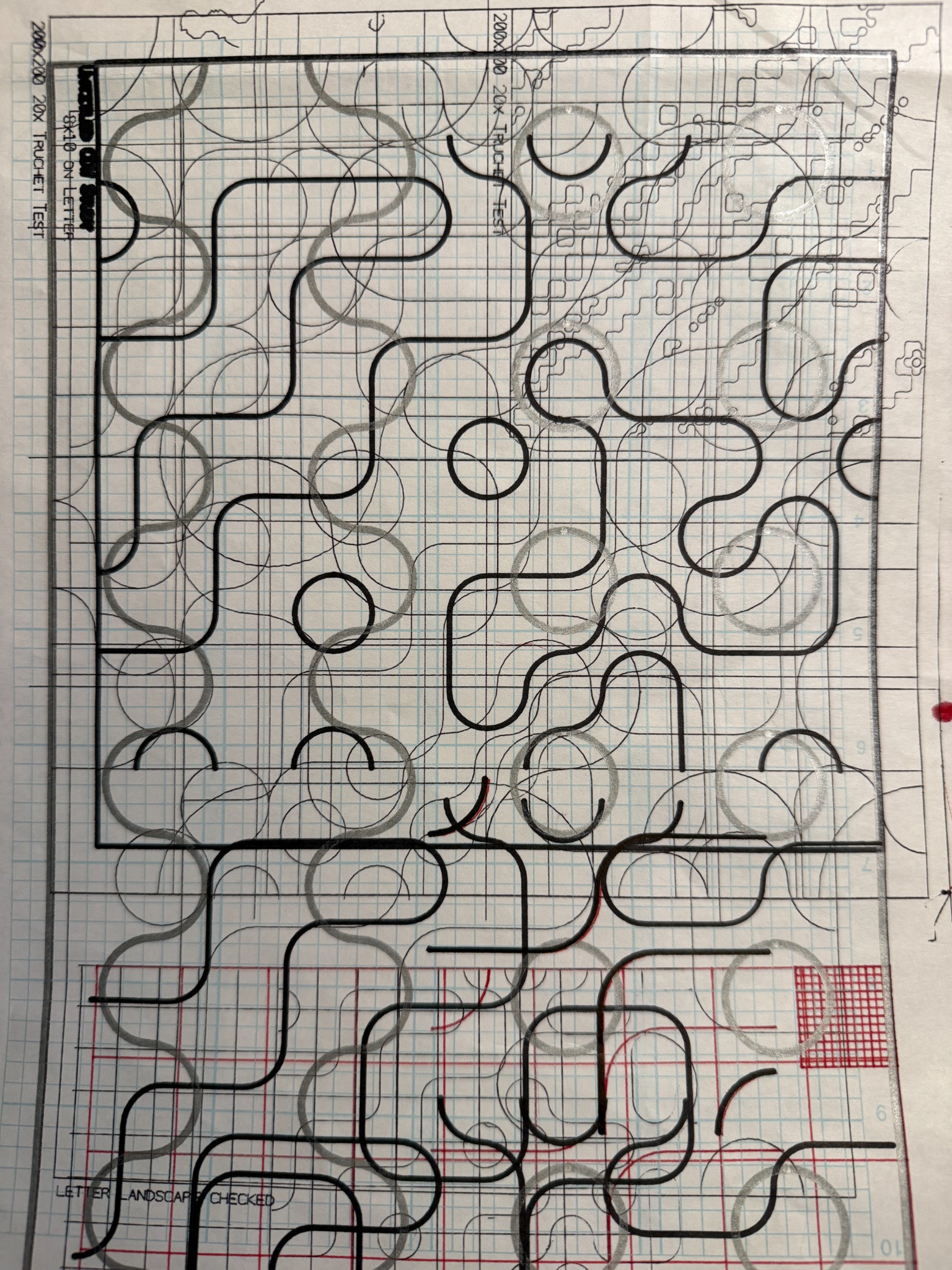
A layered Truchet test sheet, with curved paths, grid lines, and plotting annotations.
In March, I asked ChatGPT whether it could help me use Daniel Shiffman’s The Nature of Code to create generative code I could plot on my AxiDraw. It was a practical starting point: take ideas from a book, work through the code, and get something onto paper.
By July, the conversation had become more specific. I was asking about Northwest Coast formline art, how its shapes and relationships might be described computationally, and whether those ideas could connect with Truchet tiles.
I brought several references into the discussion, including the Sealaska Heritage Institute’s formline art kit and research from the Bridges mathematical art conference. One was Izzy Snyder’s paper on rendering grayscale images with generalized Truchet tiles, which explores varying the darkness inside tiles while keeping their edges compatible.
Those references led to different kinds of questions. How do shapes connect? What happens to the spaces between them? What could become a drawing rule, and what needs more understanding before it becomes code? The formline discussion also raised an important boundary: studying construction and relationships is different from treating culturally specific imagery as interchangeable pieces for a generator.
The software idea grew quickly. I asked for a specification that Codex could use to build a macOS desktop application, with open-source tools and the possibility of Windows and Linux versions. We were also discussing a larger reference collection, something we were calling a computational design bible.
At one point I asked whether this would take years, or thousands of dollars in ChatGPT and Codex credits. Then I brought it back to a smaller requirement: “I'd like a v.0.1 that has some usable functionality as an outcome...”
That question kept the discussion connected to making something.
The name changed along with the scope. We talked about a Computational Design Toolkit, then Computational Design Workbench. I liked the latter. The conversation was expanding beyond one kind of tile or one visual reference.
Some of the most useful material came from describing things I already did in my own drawings. I use parallel lines with hatch marks between them, then recursively nest more marks between the perpendicular divisions. The spacing and density build tone and value. Explaining that process meant slowing down something I would normally do by hand and asking what its decisions actually were.
That brought us back to basic drawing questions. In high school art classes, I had worked from line into tone and value, using charcoal, chalk, and black-and-white tempera. We learned to look at a still life and mix the values we saw. In the CDW discussion, I was asking how that movement between looking and making might relate to a computational system.
I described it as “Almost the internal dialog between canvas/paper, hand/eye, and brain”.
Then came the harder questions. How do you know when to stop? How do you avoid overworking something? What happens when you try to quantify balance, contrast, hierarchy, or white space? When the conversation introduced a design scorecard, I pointed out the tension between qualitative judgment and numerical rules.
We also talked about recognizing an artist through small decisions: their marks, palette, medium, the way a line crosses a border, or how a figure is drawn. That opened up the possibility of studying individual drawing habits, including my own.
These were questions and proposed directions. Artist interviews, a research mode, and a notebook that might collect reflections were ideas for exploration, not working features or completed plotting experiments.
Eventually I asked for something tangible outside the chat: project files, Markdown documents, and a handoff to Codex. I also asked whether I would get the same conversational input there. The developing workflow separated the discussion and review from implementation, with written files carrying the decisions between them.
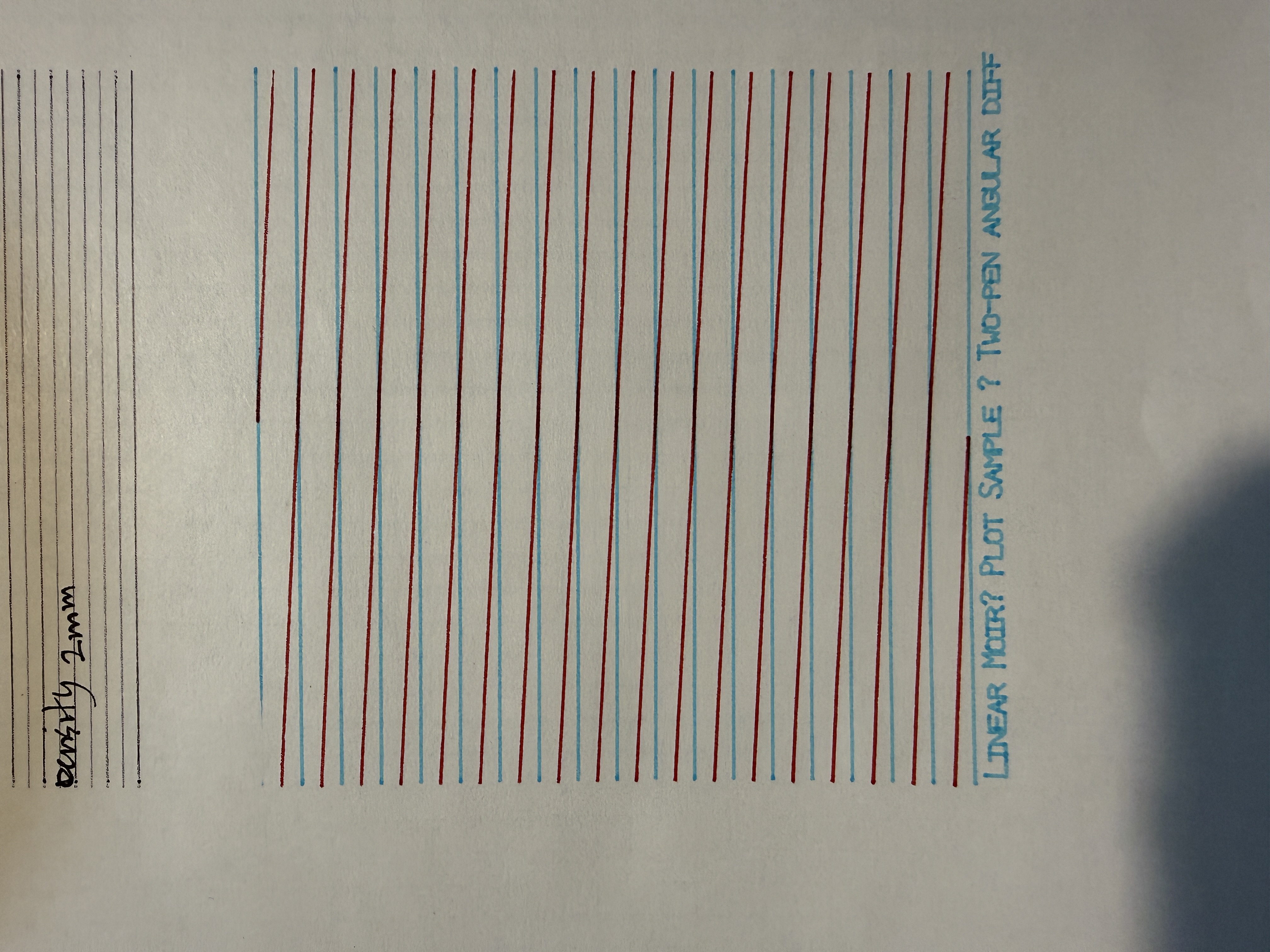
A two-pen linear moiré study in red and cyan, with annotations. Photograph captured July 17, 2026.
Looking back from November
I’m comfortable being open about how much AI has helped with this project. I’m not a software developer, but I understand the concepts and can describe what I want to explore. ChatGPT has helped me work through those ideas, and Codex has helped turn them into software I can test. I bring the drawing experience, the questions, and the judgment about whether the result is doing what I intended.
I would not be this far along if I had started coding everything on my own. Books like Daniel Shiffman’s The Nature of Code and Carl Lostritto’s Computational Drawing are great resources. For me, reaching this point through learning and coding alone could have taken years. Working with these tools has shortened the distance between an idea and something I can try, critique, and revise.
There are also excellent existing programs in this field. DrawingBotV3 turns photographs into drawings suitable for pen plotting. I’ve also purchased Patternodes, which uses connected nodes to build generative designs, vector patterns, and animations. DrawingBotV3’s creator is also developing Artrinth, formerly Drawing Studio, which is currently in alpha testing. CDW is developing alongside that wider community of tools, shaped by the particular drawing questions I want to investigate.
Looking back at those early conversations, alongside the plans for a desktop application were questions about marks, perception, judgment, and when to leave a drawing alone. The first version still needed to do something useful. The larger questions gave us something worth testing.
References
Daniel Shiffman — The Nature of Code
Sealaska Heritage Institute — Formline Art Kit
Izzy Snyder — Generalized Truchet tiles