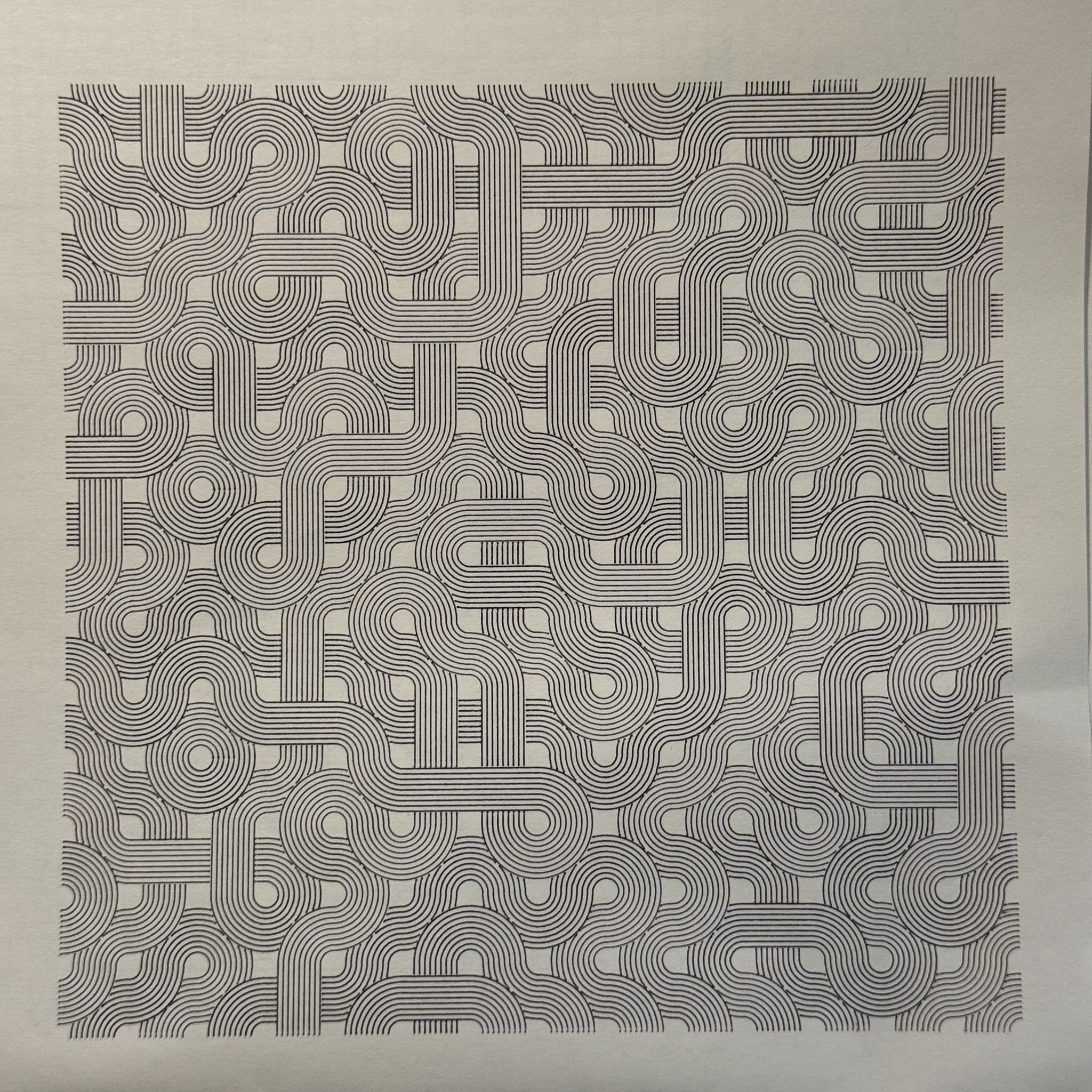
Retrospective journal · July 11–26, 2026
On July 11, I had a short response to an early version of CDW’s Square Truchet generator: “Working well!” The first set was small: quarter turns, straight connections, opposing turns, and empty cells. It was enough to start seeing what those pieces could do together.
The tiles occupied a square grid. Their connections had to agree at neighboring edges, so the larger arrangement could hold together as the individual pieces changed orientation. A seed made it possible to return to a particular arrangement rather than lose it in another random generation.
We had considered a crossing tile as well, but left it out of that first implementation. Four types gave us something manageable to build and test before adding more possibilities.
This was part of the back-and-forth between ChatGPT, Codex, and me: discuss the structure, implement a limited version, review what it produced, and decide what to try next. At this stage, the development report included checks that a saved and reopened project produced the same SVG. That was useful groundwork, but I also wanted to see the lines on paper.
Getting it onto paper
On July 16, I shared a physical Truchet sample and described a fairly practical problem. The sketchbook had been too close to the plotter. The machine contacted it, nudged the page, and left lines misaligned.
That gave us something concrete to examine. The generated geometry and the physical setup were different parts of the process. A drawing could be correctly constructed in the file and still be interrupted by something as ordinary as where I had placed the sketchbook.
The project’s plotting records also preserve an intentional two-color offset and a separate paper-movement example. Together, those observations make a useful distinction: a shift between lines can be something I choose, or something that happens during plotting. Keeping notes about the process helps explain the difference.
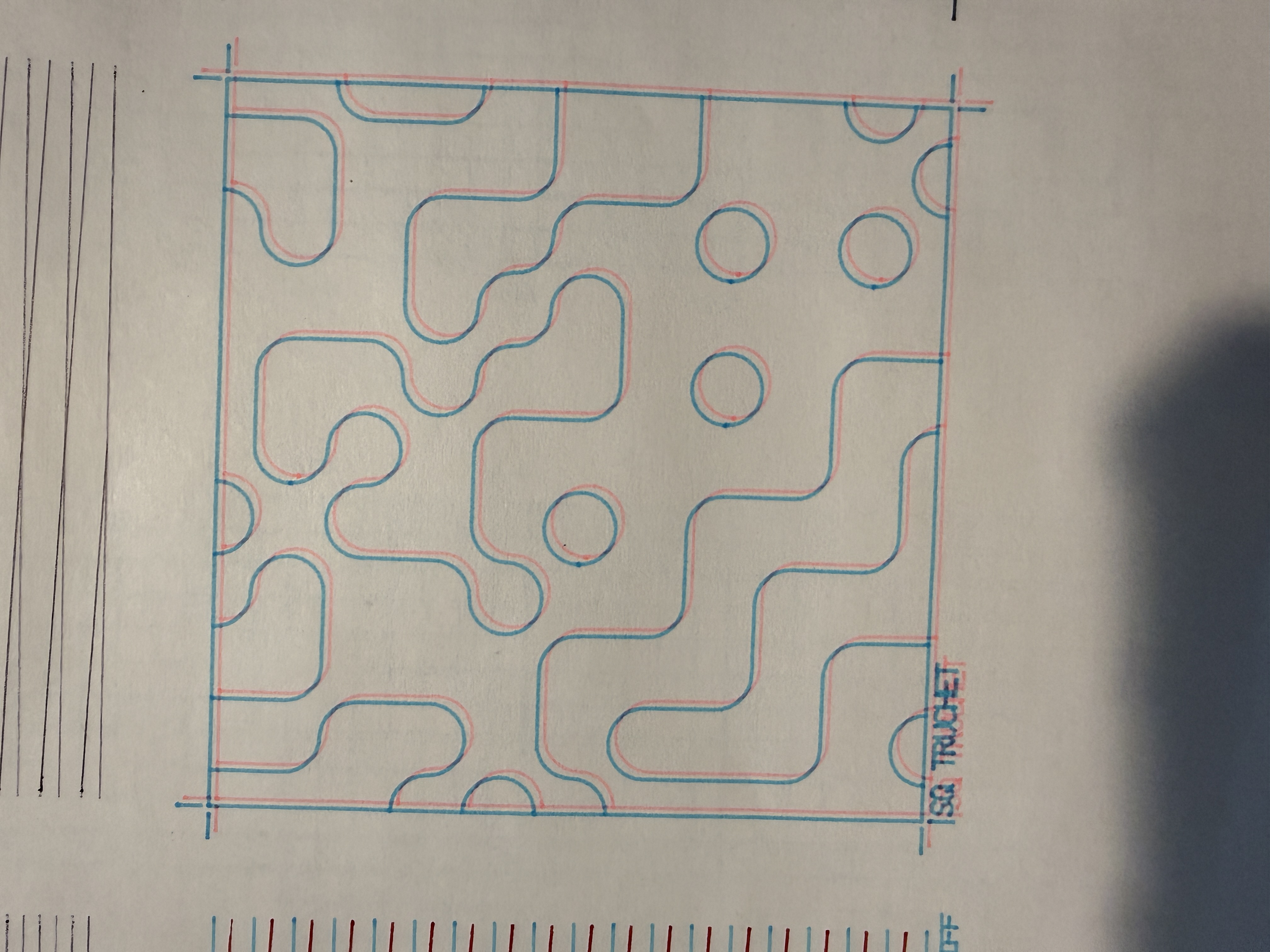
Square Truchet with an intentional color offset of approximately 1 mm. Photograph captured July 17, 2026.
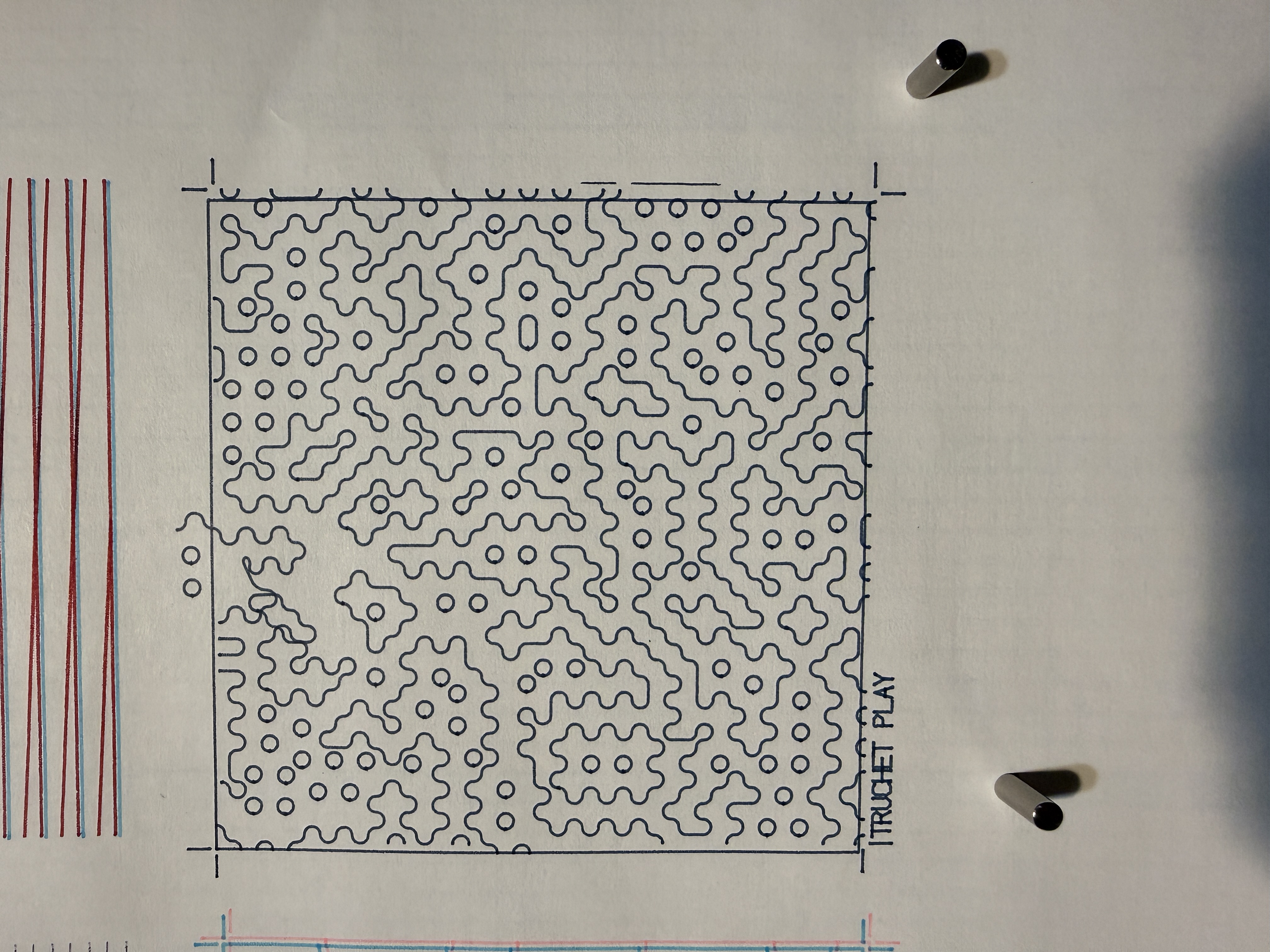
Truchet Play: the paper moved during plotting, displacing parts of the drawing. Photograph captured July 17, 2026; this does not establish the exact plotting date.
The empty tile was part of the drawing vocabulary too. Leaving a cell empty changes the arrangement just as placing another curve does. It gave us a simple way to consider the spaces between marks while the rest of the generator was still relatively small.
After sharing the physical sample, I asked about adding hatching or stippling to regions, including spaces that were not already represented as closed paths.
That question reached beyond the first tile generator. An open line does not automatically describe the boundary of an area to fill. We would have to decide what counted as a region and how to find it before deciding what marks belonged there. It remained a design question at that point, rather than a finished fill tool.
Looking beyond the first vocabulary
Later in July, I brought in Jerad Maplethorpe’s Masters of Truchet. By then, CDW already had a working square-tile generator and physical plotting experience. The article became a reference for where the experiments might go next.
One useful direction was to separate the placement system from the particular shapes it placed. If the grid and connection rules could be reused, we could try another tile vocabulary without rebuilding everything around it.
That did not guarantee an interesting drawing. My reaction to an early Angular Ribbon version was that it was not especially impressive. Getting a generator to run and finding a visual result worth pursuing were separate parts of the work.
Projects such as MarkJB’s Patterned Grid and DRynne’s Multiscale Truchet entered the discussion as references. They gave us other structures to study while considering what made an arrangement feel richer than the first small catalog.
The next step was not to add every possibility at once. We had a working starting point, some paper evidence, and more specific questions about connection, variation, and space.
Those early tiles gave us a way to work: make a limited change, examine the drawing, try it on paper, and let the result inform the next question. The ribbon experiments would give that process another direction.