Retrospective journal · July–October 17, 2026
In July, my response to an early Angular Ribbon experiment was that it was not too impressive. CDW could generate the pattern, but I wanted to explore other possibilities.
The next question was what to change. Did the system need more kinds of tiles, different proportions of the existing ones, or a stronger sense of connection across the page?
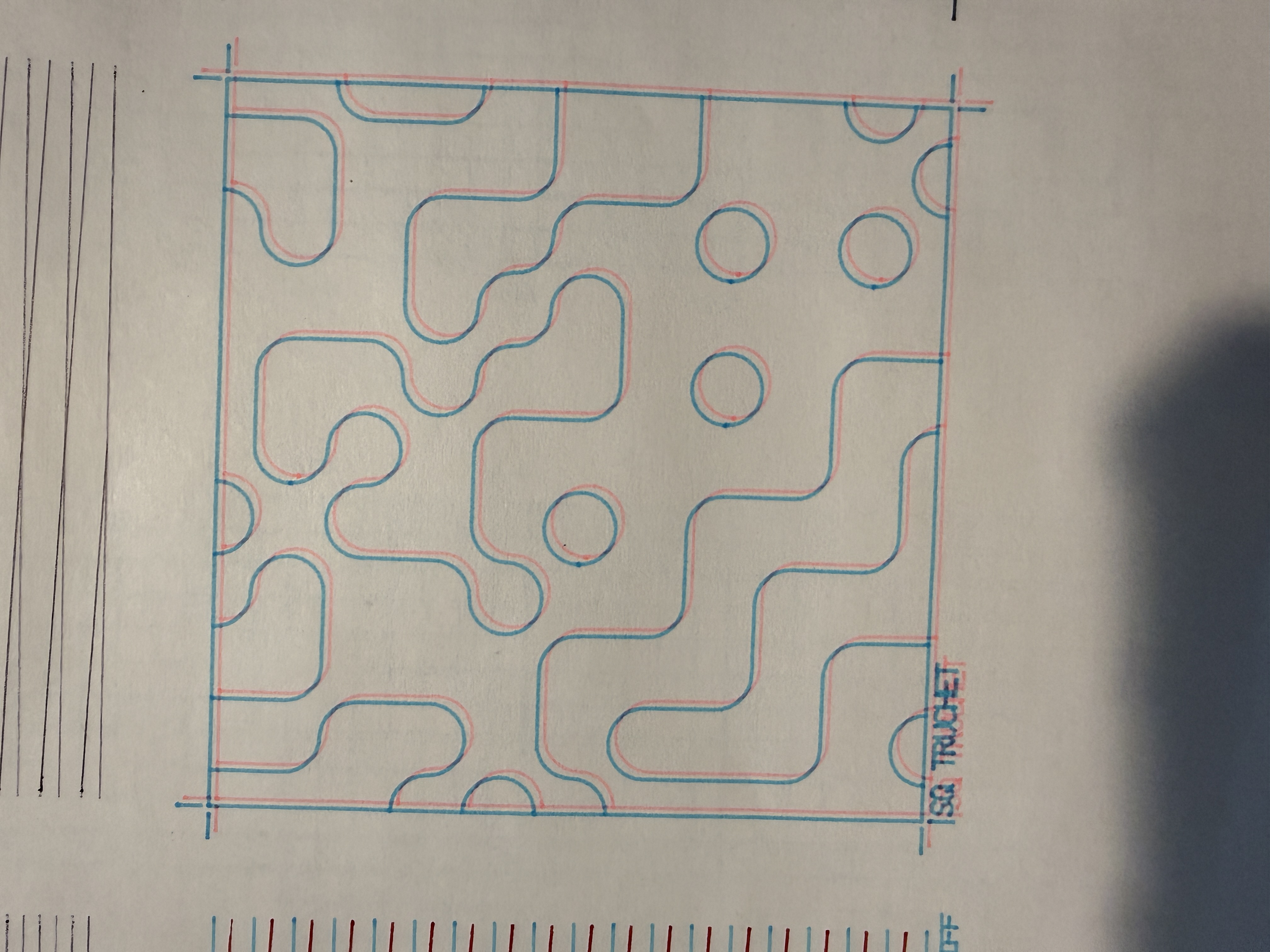
That led into Patterned Grid work: a broader set of motifs, with decisions about how neighboring pieces could connect. The early Angular Ribbon catalog, Patterned Grid, and the later Ribbon Truchet work were related explorations, rather than one generator that simply changed its name.
Giving the pattern room
The July review made a useful distinction. The underlying system was working, while the catalog still needed tuning. Edge-compatible arrangements were the stronger starting point. Weighted randomness remained useful for texture, but could become visually noisy.
That directed the next work toward the frequency and shape of the marks: how often a crossing appeared, how much space remained, and whether parallel accents were contributing to the arrangement or crowding it.
One of the paper studies is labeled as a tuned, balanced Patterned Grid with a 20-by-20 grid and seed 102. Its stepped loops, short parallel strokes, crossings, and open areas make those decisions visible. There is room to follow individual paths, as well as to read the whole square.
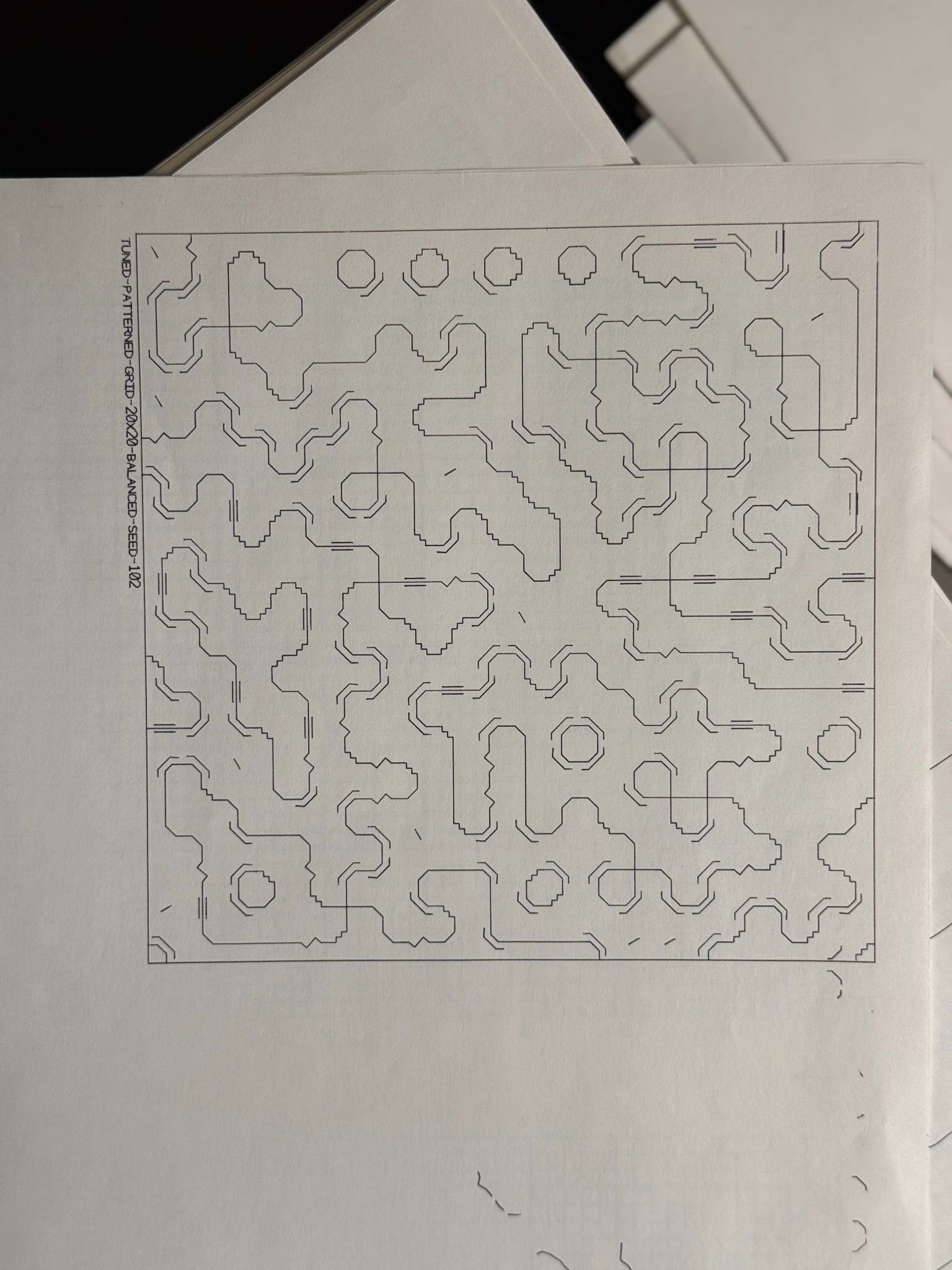
Patterned Grid study labeled “20×20 Balanced, Seed 102,” with stepped loops, crossings, and short parallel accents.
MarkJB’s Patterned Grid and DRynne’s Multiscale Truchet were references in the discussion. They helped broaden the questions we were asking. That did not mean importing every possibility into CDW at once. Multiscale layouts and a general plugin system remained future directions in that stage of the work.
Following a band
By October, I could describe the direction more clearly: I preferred the continuous flow of ribbons.
Parallel lines change how I read the pattern. They gather into bands that turn, loop, and travel across the arrangement. In the black-line ribbon study shown here, the small spaces between those lines remain visible, while the larger spaces become pockets between the bands.
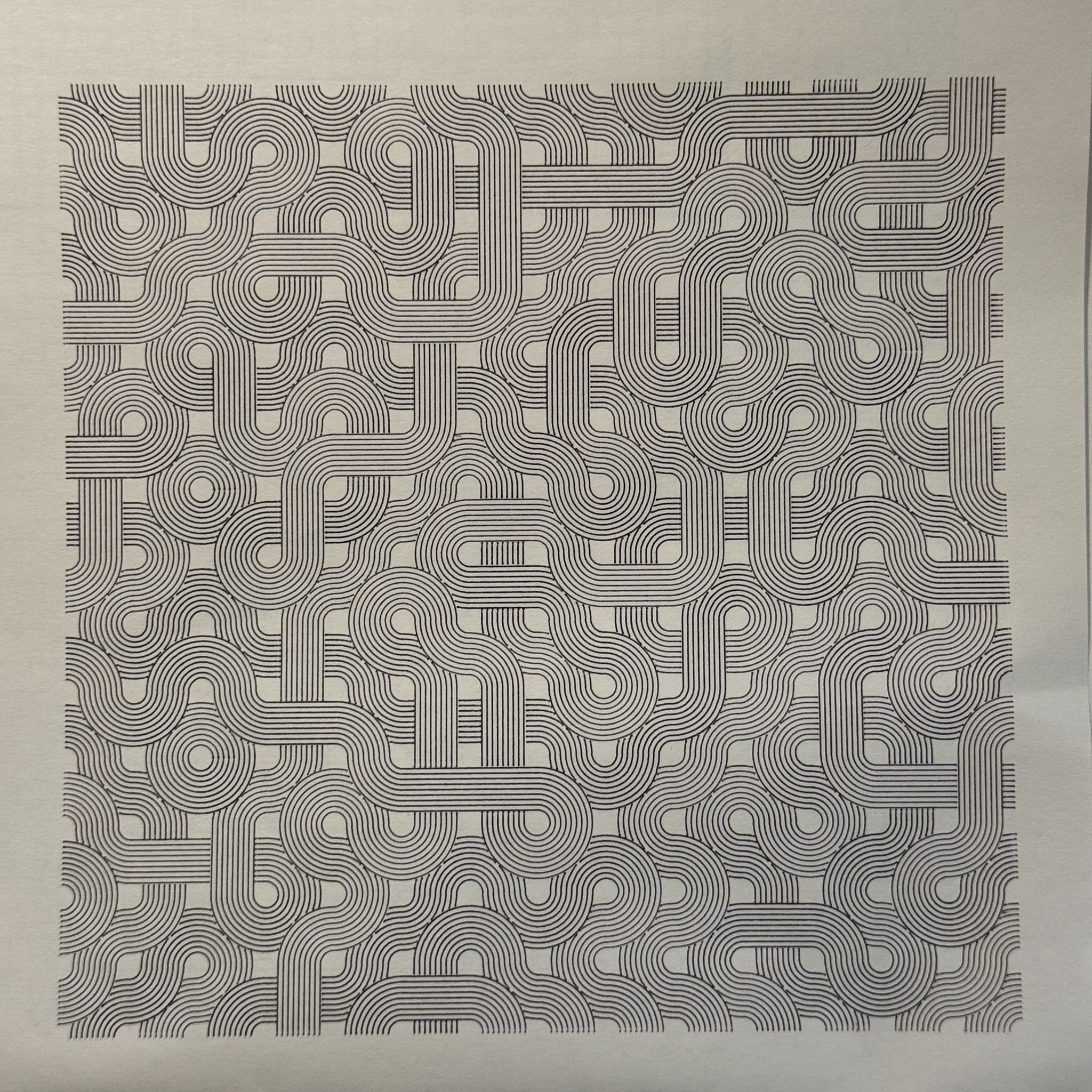
Parallel lines form looping ribbon bands, with interruptions that suggest one band passing over another.
Crossings introduce another decision. Drawing every line through an intersection produces a different result from interrupting one band so another appears to pass over it. For a pen plot, that interruption has to exist in the paths the machine draws.
The October development work addressed overlap trimming. On October 17, I reported that a two-color ribbon overlap plot had worked well. That was a physical result, beyond looking at a preview. It also gave us a specific successful test without settling every other combination of settings.
More questions to try
The ribbon work immediately suggested further variations. I asked about square corners, rotating the overall grid, and allowing the drawing to extend beyond the page or be cropped at the margins.
I also wondered whether three paths, with a broad marker on the center path and finer lines outside it, could suggest a filled ribbon. That was an idea to investigate, including how pens would be assigned and how their actual widths would meet. It was not yet a demonstrated result in this part of the story.
The useful progression was from a general reaction to more specific drawing decisions. A pattern could be technically sound and still need a different balance of marks. A ribbon could look continuous on screen and still need a physical test at its crossings. Each comparison gave the next experiment something clearer to work on.