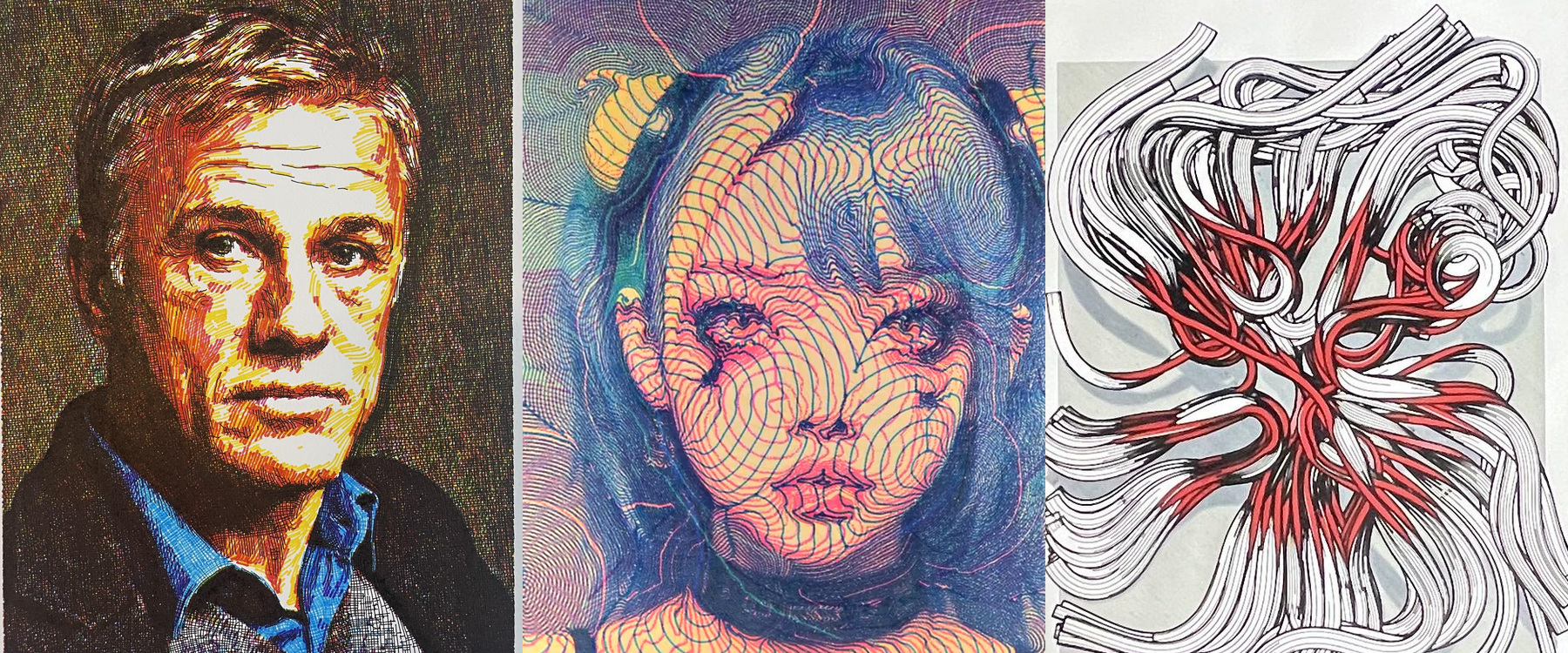
Three posts from the PlotterArt community have stayed in my inspiration notes: a mountain drawing, a field of plotted dots, and a generator for small cities. Each takes a different route from a system of rules to marks on paper. Together, they offer plenty to think about as I continue working on CDW Studio.
Following the shape of a mountain
Mark Roland’s mountain drawing uses strokes that follow the terrain’s slopes. Against the closely spaced lines of the sky, changing direction and density across the ridges give the landscape a strong sense of depth.
Mark explains that the scene uses real elevation data and a camera placed at specific coordinates. His post also opens a discussion about using an AI agent to help write the shader that produced the slope-following effect.
This caught my attention while thinking about terrain hatching. The direction of a line can describe a surface, while its spacing helps describe the light. There is a lot to explore between those two decisions.
See Mark Roland’s original post and discussion.
A million steps, one dot at a time
The artist posting as u/watagua, also @jaymezd on Instagram, created a drawing from four interacting turmites. These small rule-driven agents move through a grid and change the cells they encounter. After more than a million simulated steps, the result became 172,788 plotted dots.
The finished work combines pink and purple areas with dense, almost circuit-like patterns. It’s a reminder that a plot doesn’t need to begin with a recognizable subject. A few local rules can build a much larger visual structure.
For my own experiments, I’m interested in how the starting conditions, rules, and stopping point change the image, and what happens when those results meet a particular pen and paper.
Watch the original plotting process.
A city built for the pen
Plotropolis, shared by u/BelvedereFrothingham, builds seeded isometric cities for pen plotting. Its streets, buildings, waterfront details, and roof patterns give the eye plenty of places to wander.
The creator describes hidden-line removal, hatching constrained by the selected pen width, and SVG layers organized by pen. That attention to the physical drawing is as interesting to me as the city itself. The scene needs to work as paths, with deliberate choices about what is visible and how much ink fits into a space.
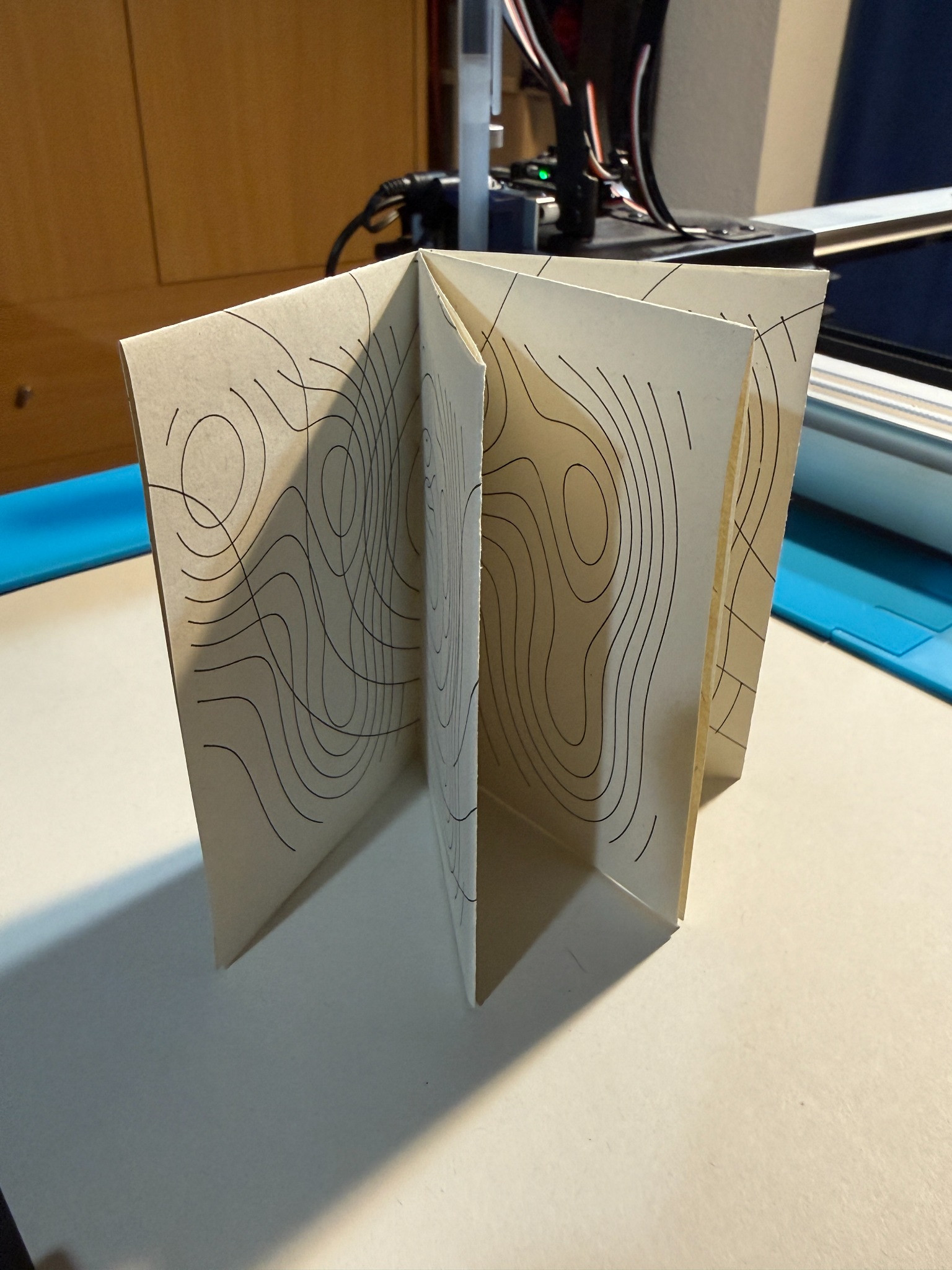
It also suggests a direction for small-format work: a series of neighborhoods, different views, or a city explored across the pages of a zine.
Read the original Plotropolis post or explore the generator.
Keeping the ideas moving
These are references for further exploration, not a list of features already in CDW. What connects them for me is the relationship between rules, line or dot placement, and the physical result. There is plenty of room to learn from each without expecting every experiment to become the same kind of drawing.
Featured image: cropped details from Mark Roland’s mountain drawing, u/watagua’s turmite plotting video, and Plotropolis by u/BelvedereFrothingham. Original artworks and images belong to their respective creators; source links appear above.