Cadin Batrack’s random-comic builds comics from a collection of hand-drawn images. The Processing application can generate a new page layout and set of images together, or recompose a single panel while preserving the layout. That second interaction is especially useful as a reference for generative tools: a promising composition can survive while one part changes.
The results depend on more than random selection. Each image can carry a focal area, minimum panel dimensions, an edge anchor, and rules for positioning a horizon line. Those small pieces of information help a drawing fit its surroundings. A face, object, or fragment can be cropped and repositioned without treating every part of the image as equally important. The asset table makes these constraints unusually easy to inspect.
The project also has a physical form. Batrack’s Vomit Comic Robot pairs the software with a Raspberry Pi and thermal receipt printer. The comic format invites a viewer to connect unrelated images into a story, while the machine turns each result into a small printed object. The artist’s project page includes examples and an explanation of the process.
Ideas to explore in CDW
A small experiment could start with a fixed grid and a library of original vector motifs. Each cell would have its own saved random seed, so rerolling one cell would leave its neighbors unchanged. A separate command could regenerate the layout. Focal bounds, anchors, and minimum sizes could keep each motif legible, with Undo making the experiment reversible.
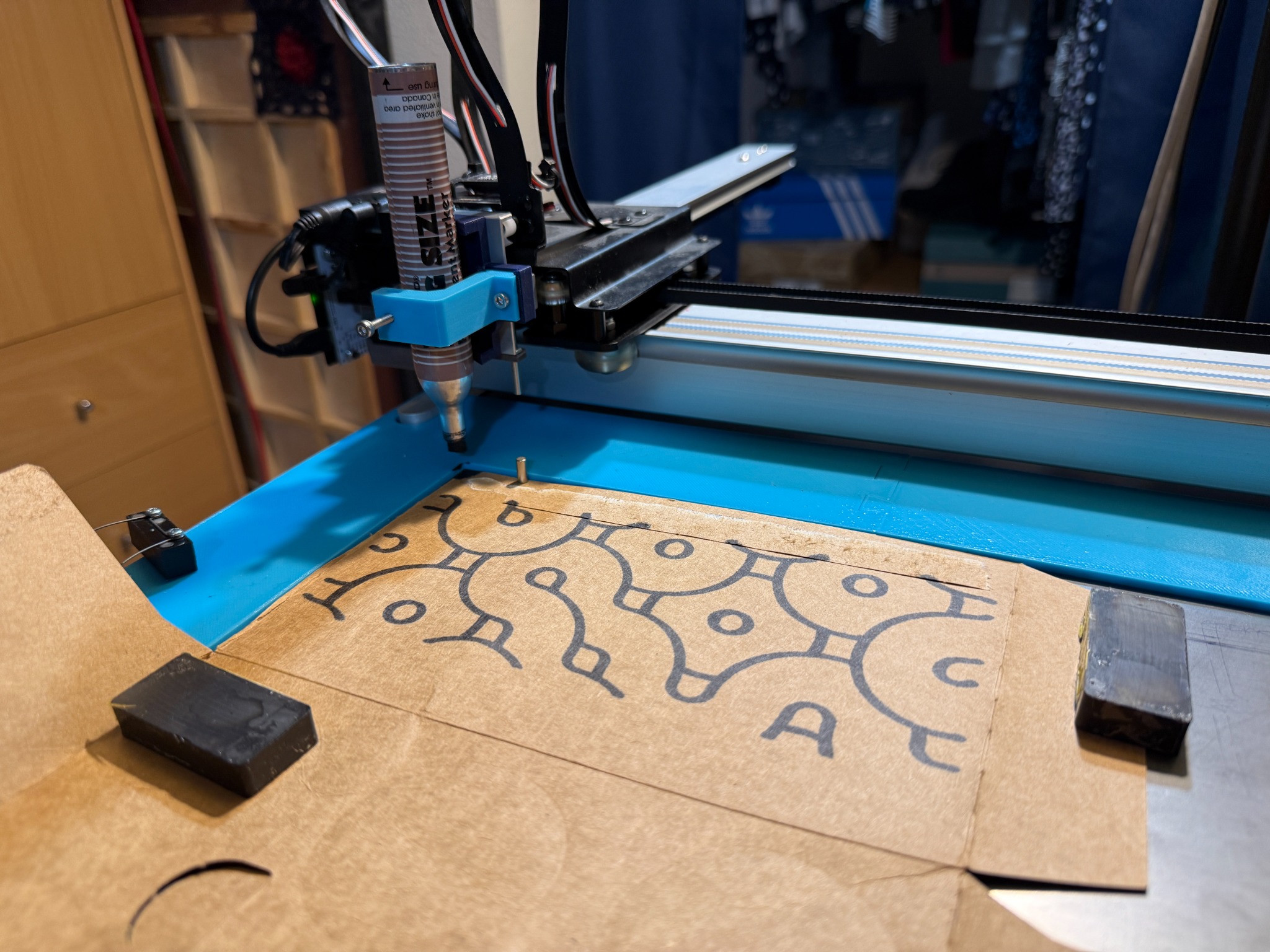
For pen plotting, those motifs would need explicit paths, clipping, and pen assignments. Random-comic itself composites raster images and saves PNG files; it does not provide a vector plotting pipeline. This is a proposed direction for CDW, rather than a description of a feature already implemented there.
The repository is released under the Unlicense. The most useful starting point is its separation of page-level structure from local variation: decide what should remain stable, then give chance a smaller area to work in.